
Carpenter Bees Are Drilling Into PA & DE Homes Right Now
Spring has arrived, and so have the carpenter bees. Learn how to identify them, spot the damage early, and protect your home before the holes multiply.
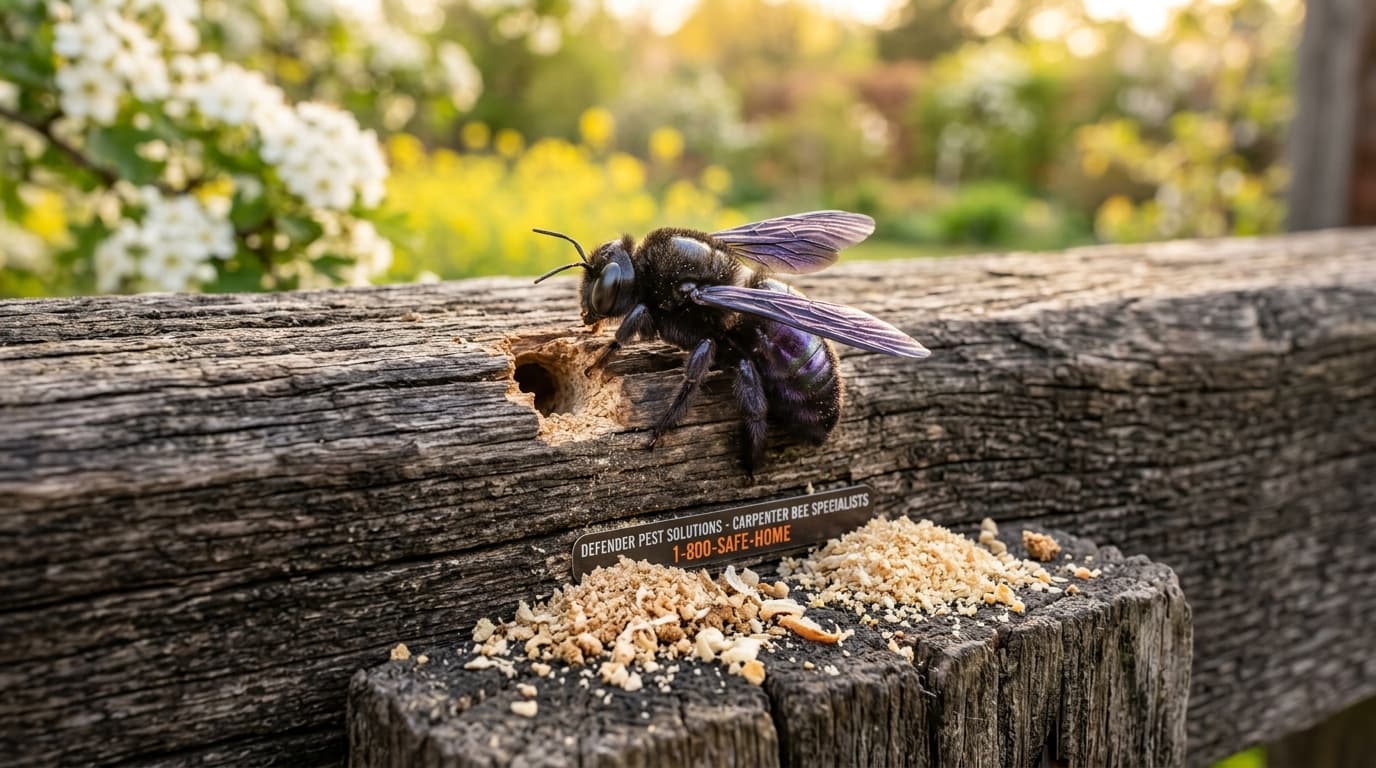
They're already drilling. Spring is the critical treatment window. One untreated female this spring means 6–8 new bees this summer — each boring additional tunnels.
What Are Carpenter Bees?
Carpenter bees are large, solitary bees common throughout southeastern Pennsylvania and northeastern Delaware. Unlike bumblebees, they don't live in colonies — each female bores into wood to create a nest gallery where she lays her eggs.
They're often mistaken for bumblebees, but there's one easy way to tell them apart: look at the abdomen. A carpenter bee's abdomen is shiny, black, and hairless on top. A bumblebee's abdomen is fully covered in fuzzy hair.
Despite their intimidating size (¾ to 1 inch long), carpenter bees are generally docile. The males — the ones that hover near your face and buzz aggressively — can't sting at all. The females rarely sting unless directly handled.
Carpenter Bee vs. Bumblebee vs. Honeybee
The species in PA & DE is the Eastern carpenter bee — here's how to tell them apart.
Carpenter Bee
- ¾–1 inch long
- Shiny, bare, black abdomen
- Yellow fuzz on thorax only
- Bores into wood — solitary
- Males cannot sting
Bumblebee
- ½–1 inch long
- Fully fuzzy abdomen (yellow/black)
- Fuzzy all over — social colony
- Nests underground
- Can sting if threatened
Honeybee
- ~½ inch long
- Fuzzy, golden-brown striped
- Social — large colonies in wax hives
- Managed commercially for pollination
- Can sting; colony defensive
Where Do Carpenter Bees Bore?
Carpenter bees target unpainted, unfinished, or weathered wood. Painted wood is rarely attacked — the paint seals the surface they need to grip. They prefer softwoods like pine, cedar, and redwood, and they like wood at least 2 inches thick.
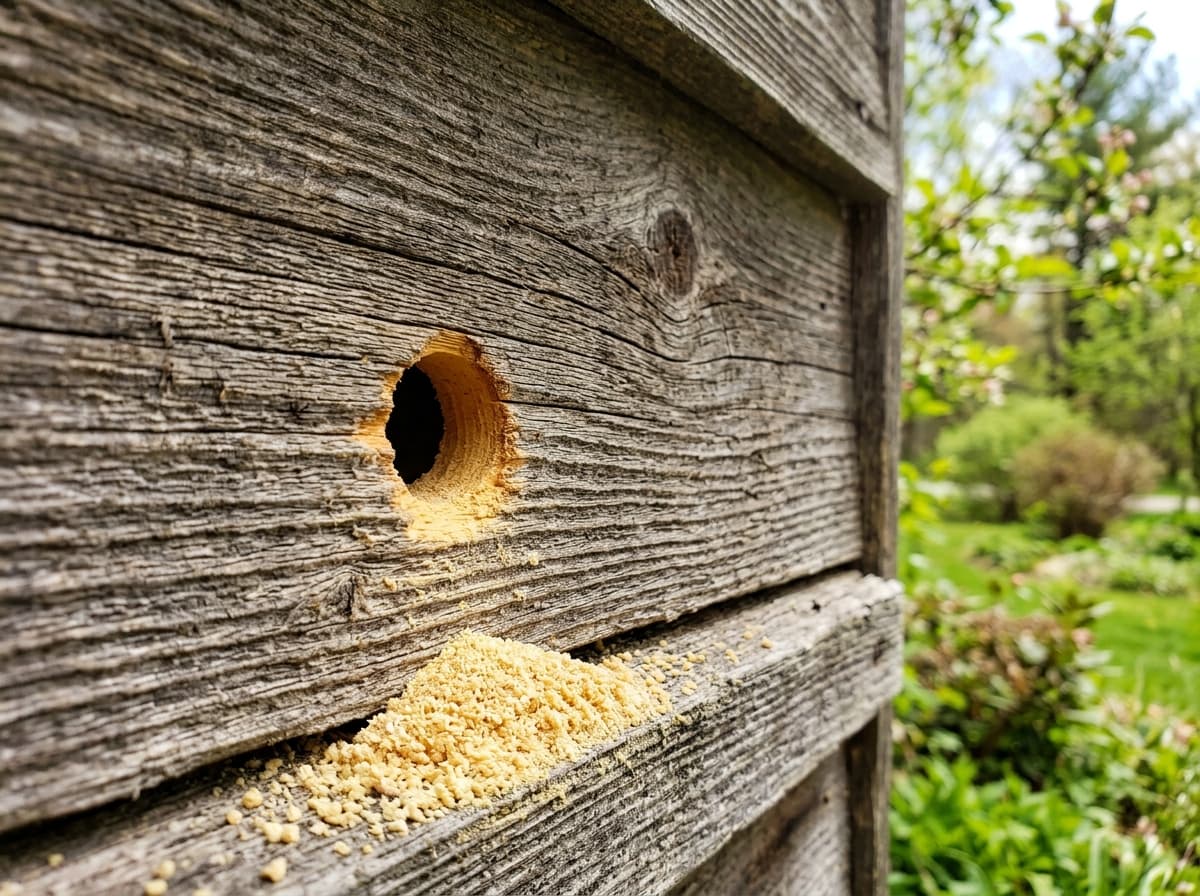
Important: Carpenter bees do NOT eat wood. They excavate tunnels purely for shelter and nesting. The tunnels — called galleries — start as a perfectly round ½-inch entry hole, go in about 1–2 inches, then turn 90° to follow the wood grain. A single gallery can run 6–12 inches long. Over multiple years, successive generations can expand galleries up to 10 feet.
Common nesting locations:
- Roof eaves and soffits
- Fascia boards
- Deck railings, posts, and framing
- Porch columns and overhead overhangs
- Wooden siding and shingles
- Window and door frames
- Fence posts and outdoor furniture
- Shed walls and outbuildings
Signs You Have Carpenter Bees
Check your home for these telltale signs:
Perfectly round holes (~½ inch diameter) in exterior wood
Piles of coarse sawdust (frass) beneath entry holes
Buzzing or droning sounds from within the wood
Fan-shaped yellow stains below holes — waste that darkens with mold
Large bees hovering near wood surfaces
Woodpecker damage nearby — they hunt carpenter bee larvae
💡 Pro tip: If you see a yellowish, fan-shaped stain pattern below a round hole in your wood, that's almost certainly a carpenter bee gallery above.
Why Carpenter Bees Are Dangerous
The Compounding Problem
One hole in your fascia board might seem like a minor cosmetic issue. It's not. Carpenter bees return to the same wood year after year. Each generation expands and branches the existing gallery system.
One untreated female this spring means 6–8 new bees this summer, each boring additional tunnels. Over 3–5 years, this compounds into significant hollowing of structural beams, fascia boards, deck posts, and roof overhangs.
Secondary Damage Adds Up
- Moisture intrusion — open tunnels let water in, accelerating rot
- Mold growth — from accumulated waste inside galleries
- Woodpecker damage — woodpeckers are attracted to larvae and will hammer open your wood
- Secondary pest infestations — galleries attract mites, beetles, and other insects
The Cost Reality
If Treated Early
Professional treatment: hundreds of dollars
If Left Untreated for Years
- Replace a single fascia board: $500–$1,500+
- Deck post or structural beam repair: $1,000–$5,000+
- Extensive multi-year damage: $3,000–$10,000+
Carpenter Bee Season in PA & DE
If you're seeing carpenter bees right now, you're right on schedule.
Adults emerge from overwintering tunnels when temperatures reach 65–70°F
Mating occurs; females search for nest sites and begin boring
Peak boring and egg-laying — females create 6–8 brood cells per gallery
Larvae develop and pupate inside sealed gallery cells
New adult bees emerge and feed on nectar before returning to overwinter
Adults overwinter inside existing galleries; no activity during cold months
Why Spring Is the Critical Treatment Window
April and May are the ideal months for treatment. At this point, overwintered adults are concentrated in known galleries — before they mate and start new tunnels.
Schedule Spring TreatmentDIY vs. Professional Treatment
| Issue | DIY Risk | APS Approach |
|---|---|---|
| Misidentification risk | Not every large bee is a carpenter bee — you don't want to treat beneficial bumblebees or honeybees | We correctly identify the species before treatment begins |
| Timing mistakes | Sealing holes too early traps bees inside without contacting the treatment | We time applications so bees contact the treatment before any sealing occurs |
| Incomplete treatment | You can't see the full gallery system; branched tunnels and secondary holes are easy to miss | We treat the complete tunnel system, not just visible entry holes |
| Safety concerns | Insecticidal dust becomes airborne; ladders needed for eave treatment | Licensed technicians handle all products safely at any height |
| Product selection | Not all insecticides are formulated for tunnel application into wood | We use professional-grade products formulated for carpenter bee galleries |
| Sealing protocol | Plugging holes immediately defeats the treatment | We seal 1–2 weeks after treatment, using proper materials for long-term prevention |
Claim 10% Off + Free Estimate
Use code CBT26
April and May are the ideal treatment months. Book your free quote now before carpenter bees start new tunnels this season.
- ✓Response within 1–2 business hours
- ✓Licensed & insured in PA & DE
- ✓Free estimate, no commitment required
- ✓5.0 ⭐ rated by 40+ customers
Claim Your 10% Off + Free Estimate
Tell us what is happening and where. APS will follow up quickly with the next best step.
Spring Special
10% OFF with code CBT26
Protect Your Home This Spring
Don't wait for the damage to get worse. Carpenter bees are active right now in PA & DE, and every day counts.
Also see: Identification Guide →